FULL STORY IN THE
CAMELFORD & DELABOLE POST THURSDAY 15th JULY!
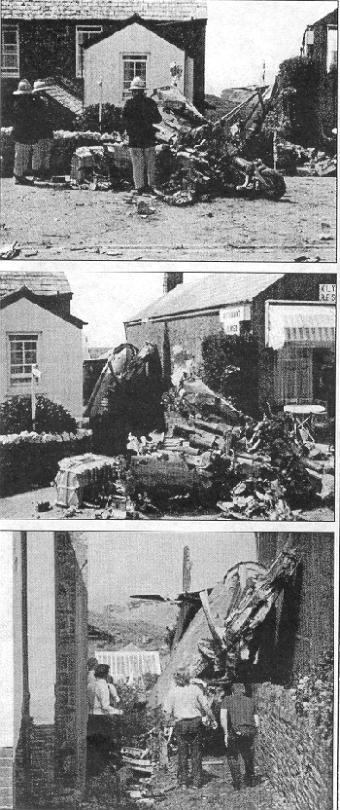
On Friday July 6th 1979, villager and holidaymakers had a
miraculous escape when an out of control RAF fighter jet ploughed into the
village just yards away from a loaded petrol tanker.
The
pilot, who was on a training flight, experienced control difficulties and had to
eject into the sea leaving his Hawker Hunter jet to crash into the ocean.
Instead it veered towards land, hurtling at 250mph, a major disaster seemed
inevitable. But it was nothing short of a miracle when the jet ended up wedged
in a 12' gap between Klymiarven Guest house and King Arthur's Terrace, damaging
just three cars, a greenhouse and a swimming pool in it's wake. Guesthouse
owners, Jim White and John and Muriel Jewell, said they were lucky to be alive,
along with Ivan Irons, who was up a ladder painting the first house to be hit, Westmead
in Atlantic Road. Garage owner Jack Cann, was preparing to receive1,500 gallons
of petrol when the pieces of the jet landed only 10 yards away. If the jet had
exploded the whole village would have gone up. If the jet had not been stopped
by the houses it could have ploughed down the high street killing many
holidaymakers. In this amazing incident no one was seriously injured and even
the pilot survived after being picked up by a Port Isaac fishing boat, the Lady
Jane. At the time the plane crashed I was on the phone speaking to Fred Whiting,
who at that time owned the launderette in Tintagel. I remember we were speaking
about a TV repair when he suddenly said "I've got to hang up the phone...a
plane is coming straight at the house!". In fact it ended up a few yards
away from his house as it veered across a field before hitting Klymiarven and
King Arthur's Terrace. I quickly gathered up a few movie films, grabbed my
camera and dashed down to the scene. I shot quite a lot of film at the time and
later showed it at the Social Hall in Tintagel at a special thanksgiving night held
by the Parish Council. It really was an incredible escape from a major disaster
in the village and as the accident took place a the height of the tourist season
the fact there was no loss of life added to the "Miracle Of Tintagel" (Acknowledgements to "Memories of Boscastle &
Tintagel" by the Cornish & Devon Post) for the photographs and major
part of the text).......David Flower
For the record the serial number of the Hunter
MK F6 was XG197 and it was serving with
No1 TWU (Tactical Weapons Unit). (Thanks
to David W. Earl author of 'Hell On High Ground'
Vol1 & 2 for this information...David Flower) THE PILOTS TRUE ACCOUNT OF
THE INCIDENT THIS TRUE ACCOUNT IS COPYRIGHT AND MUST NOT BE
REPRODUCED WITHOUT THE CONSENT OF TINTAGELWEB
Tintagel 6th July 1979 by Alick
Nicholson, Pilot of the Plane
On 6 July 1979 a Royal Air Force Hawker Hunter aircraft crashed on the town
of Tintagel. I was the pilot of that aircraft. Over 26 years have passed since
the accident, yet I still see comment on the incident, some of it on the web,
much of it inaccurate, and I am aware of continuing interest from some quarters,
and so I believe that it is time to set the record straight. This, therefore, is
my account of what happened.
In 1979 I was employed as an instructor at the Tactical Weapons Unit at RAF
Brawdy, in southwest Wales, with 79 Squadron. In addition to being a Qualified
Weapons Instructor (QWI), for many years I had been a Qualified Flying
Instructor (QFI) and Instrument Rating Examiner (IRE), and was then regularly
flying both the Hunter and the Hawk. My primary role was training future QWIs,
which was a main task assigned to 79 Sqn. As an occasional task, I was also one
of a small number who acted as Unit Test Pilot, and in this role I regularly
flew both types of aircraft on various test schedules after major servicing or
engine changes.
I believe that I understood the Hunter well. The Hawk had only recently
entered service and we were just beginning to use it as a tactical and weapons’
platform. It was a nice enough aircraft, but came nowhere near the Hunter in
terms of the sheer joy of flying and fire power. However, all the pilots were
aware that it put the Hunter well into the shade in terms of reliability and
safety. Along with all the other staff pilots at Brawdy, I had recently come off
a front line aircraft where it was inconceivable that reliability and safety
were not excellent. In my case I had flown the Phantom FGR2 with both 6 and 31
Squadron, and had developed a justified trust in that fine aircraft.
The Hunter remains one of the greatest aircraft ever built. A sensory
aircraft. Emotive sounds and vibrations; you could hear and feel the engine.
Haunting smells, especially when firing the guns. Handling that was both unusual
and magical - an interesting balance between a short stroke aileron and long
stroke elevator that gave superb lateral responsiveness coupled with stable and
very progressive pitch control. Quirky systems: a fuel system that had a sense
of humour, flaps that almost spoke to you in combat, a longitudinal control
system that could kill you at high Mach number (and that had in fact killed more
Hunter pilots than any other single cause, even though MoD had been advised of a
simple solution in the late 1950s). Four mighty 30mm Aden canons, internally
mounted, and always with you whatever other weapon load was carried, supported
by a gyro gun-sight based firmly on a WW2 design. A gunsight, it has to be said,
that required very high levels of imagination, skill and respect to comprehend
how to get good air-to-ground results from a device designed for air-to-air use.
The aircraft was also a potent force. It was fast and electronically silent.
The gun-sight radar had long been removed. There was no radar altimeter or any
other equipment that could be electronically detected. 610 knots in level flight
at sea level was not matched by many other aircraft at the time.
Despite the magnificence of the aircraft, its day had long gone. It was
unreliable: its failure rate was 3 times that of the Hawk. It was expensive to
maintain: each repair cost 4 times the average cost of a Hawk repair. It was
unsafe, but it was the Hunter - simply one of the most respected aircraft ever
to see service, and the aircraft that every pilot wanted to fly.
My story is one of mismanagement and obfuscation at the highest levels, often
by past colleagues; of incredible support from the least expected quarters; of
downright untruths by the ‘great and the good’; of lack of proper forward
planning; of disregard for the well-being of the pilots who flew the aircraft.
And so it was that I came to be flying Hunter XG 197, a Mark 6a, on 6 July
1979. The aircraft had flown less than 4 hours since the engine had been
changed, and I had flown all those hours, including the engine air test. These
flying hours had included some aggressive low level flying in Scotland with some
of my students at the end of their QWI course, and the engine had been operated
at full stretch without any problems. The night before its final flight the
ejection seat had been replaced because the one installed was time expired. The
newness of the seat harness was to have consequences a few hours later.
It had been a hectic week. My wife ran a small dairy farm, and I mucked in
when I could. Hay making was well behind schedule and being away in Scotland had
not helped the harvest. The evening of 5th July was magnificent. Warm
and friendly: one of those memorable times when neighbours really cooperate,
when everything is worthwhile, and it was after 11pm before we brought the final
load of hay into the yard. The 6th July started much earlier than
usual. A telephone call told me that an exercise had been called and this
required all aircrew and aircraft on-state as soon as possible.
I was assigned the lead of a four aircraft formation, call sign Bronze, for a
low level sortie mainly in Devon, involving simulated attacks on various
targets. Fighter opposition was to be provided by Hawk aircraft also from Brawdy.
A key part of the exercise was the preparation of the aircraft to an operational
state, and this involved loading all four guns in the Hunters with live (high
explosive) ammunition. All four guns were primed with a round in each breech, as
is normal, and the electrical firing circuits were disconnected. The guns were
therefore incapable of being fired.
It remains a great blessing that the wreckage at Tintagel did not burn, as I
believe it possible that the guns could have cooked off live rounds if they had
been sufficiently heated, and the Aden’s gas return system could have cycled
further live rounds into the breech. This was a bigger danger than the petrol
tanker that was close to the crash site, which got so much publicity, and
Tintagel was luckier than anyone realised. A year later, MoD issued a press
release in the form of a Parliamentary Question and Answer which stated that
practice ammunition had been loaded and that the guns themselves were not
loaded. This was to be one of many convenient inaccuracies. Another interesting
fact, that was never made public, is that two of the HE rounds were never
recovered. So, if you are reading this and
you have a couple of 30mm shells on your mantelpiece as a souvenir, please hand
them in to a safe place!
The flight did not start well. Two of my formation went unserviceable before
take off, though one was fixed and joined up when we were in Devon. On the run
in to the second target we were intercepted by a pair of Hawks. We countered the
Hawks, attacked the target, and then re-engaged the Hawks. As I turned in behind
one of the Hawks, at a range of about a mile, I coasted out about 5 miles north
of Tintagel and began to set myself up for an easy burst of well-tracked
gunsight film. Once over the sea I descended to very low level and accelerated
to around 600 knots to close on the Hawk that was maintaining about 450 knots.
As I closed to 800 yards I gently closed the throttle, aiming to run through
an ideal firing bracket between 400 and 300 yards. With speed dropping towards
525 knots I reapplied power to stabilize my closure rate. Immediately, the
engine surged with three very loud thuds that shook the whole aircraft. I had
experienced engine surges before, but this was different. A glance at the engine
instruments showed a large mismatch between RPM and temperature and throttle
position. The target was now perfectly positioned in the gunsight so I recorded
a short burst on the gunsight film for old time’s sake, jettisoned the external
230 gallon fuel tanks using the Emergency Jettison, started a gentle climbing
turn towards St Mawgan, and switched the radio to emergency. With the throttle
left fully open the engine RPM continued to decay as I converted speed to
height. I topped out at 3500 ft with a speed of 180 knots, which is the best
glide speed for the Hunter. A clean Hunter at 180 knots will glide 2 nautical
miles per 1000 ft, so I had a range of 7 miles and a remaining flight time of a
little over 2 minutes. I knew that St Mawgan was my nearest suitable airfield
and that it was at least 20 miles away.
At exactly the same time as my initial engine problem, Bronze 3 in my
formation came up on 243.0 MHz, the International Distress Frequency, with a PAN
call, having had a failure of both his fuel booster pumps. He wanted to divert
to St Mawgan, and Drayton Centre, the emergency controllers, took control of
him. I was about 3 miles north east of Bronze 3 when I made a MAYDAY call to
announce my engine failure. Confusion then developed. Two aircraft in the same
piece of sky, with almost identical call signs, both wanting St Mawgan. To
Drayton it must have seemed that the PAN call had simply upgraded to MAYDAY, and
I, therefore, simply didn’t exist. There was an obvious link between a fuel
problem and an engine problem, so the confusion was very understandable, but in
my cockpit there was little time or enthusiasm for sorting out the confusion, as
I still had the problem with my engine.
The RPM had by now decayed to 6100. (Note that the Hunter did not have the
normal RPM percentage gauge). I knew that the aircraft would just maintain level
flight with 6000 RPM, so getting to St Mawgan began to seem like a real
possibility, if only I could keep the RPM above 6000. But slowly, the RPM
decayed. Throttle movements had no effect. The aircraft was very quiet, but with
the engine running at low RPM I still had full hydraulics for the controls. In
the haze I could see the coast about 3 miles to my left as I headed south. It
was a peaceful few moments. What had caused the engine to surge? What had caused
the loss of throttle control? What options did I have for increasing power, even
by just a small amount? There was clearly nothing wrong with the Avon engine
itself or the airframe. It had to be the low pressure side of the fuel system.
Deselecting the Top temperature Control had no effect. Then I remembered that
the engine relight system provides an 18 second burst of fuel when the engine
relight is operated, even when the engine is already running. I was now at 5950
RPM, and operating the relight immediately gave me 6050 RPM. So it was simple: I
would go home on the relight system, relying on a quick burst of power every 20
seconds or so.
Unfortunately, my theory failed. The first burst of power was also the last
and RPM continued to decay towards 5000. I was now down to normal flight idle,
and holding 180 knots my rate of descent was picking up. 1500 ft. Land was now
coming close on my port side. I was already below the prudent ejection height
for my ejection seat. 1250ft. Drayton had finally worked out that they were
dealing with 2 aircraft, but so many other well-wishers had by now come onto the
frequency that I was unable to take much part in the radio chat. 1000 ft. The
Chivenor rescue helicopter was already on frequency and getting airborne, which
was comforting. I really was out of options. 800 ft. The surface of the sea is
now very clear but land is too close. With Tintagel Head on the nose, I gently
roll into a right turn. I know I should have gone by now. 600 ft. I continue the
turn until Tintagel Head is about 30 to 40 degrees left of the nose. 400 ft. I
am very conscious that I have stupidly run myself out of height. Probably caught
out by the rapid increase in rate of descent as RPM died, coupled with a
reluctance to admit that such a fine aircraft really was going to give up on me.
300 ft. I stretch the glide to 160 knots to briefly kill the descent rate, trim
a little nose up so that I can let go the controls without any risk of a nose
down movement, fix myself squarely in the seat, grasp the bottom ejection handle
with both hands and pull as hard as I can. 300 ft.
Instantly the canopy jettison gun fires. The canopy is gone. All the muck and
dust of ages is sucked into my space. My map follows the canopy. I know the seat
will fire a second after the canopy goes, but it doesn’t. A loud ticking noise
is in my left ear. The Time Delay Unit. I instinctively start to turn towards
this loud noise just as a sickening, crushing explosion strikes pain into the
middle of my back, followed by an even louder crack as my neck is whipped like a
rope, throwing my head into my knees as the seat fires after a very very long
one-second delay. Suddenly every tumbling and rotating sense is saturated and I
am aware of a comforting airblast. The stabilising drogue has fired and the seat
is separating. Total peace and silence. I am flying feet first over the sea with
my aircraft just a little in front and about 100 ft below me. It seems to be
maintaining height and turning very slightly left. The only noise is from my
flying suit flapping in the wind.
I am yanked abruptly away from this peaceful scene as the parachute snaps
open. Pre-landing drills. Get rid of oxygen mask, to avoid breathing in sea
water. Inflate life jacket. Lower dinghy pack by releasing the clips on each
side of the harness. Prepare for impact with the water. Rotate and squeeze the
harness release box on touchdown. Every action practised many times, and some
done thousands of times, but never with only one arm functioning. Somehow, my
right shoulder will not function. Height is too low to do much about anything.
The oxygen mask goes and the life jacket inflates just before touchdown.
Reaching the dinghy pack release clips is impossible and the release box will
not move. A rush of sea water full of bubbles. I am aware of rising to the
surface but am unable to break through into fresh air. I am floating on my back,
head down, in a very stable position supported by my life jacket and by the
dinghy pack still firmly attached to my backside. However much I struggle with
the release box with one hand, it simply refuses to open. The new straps just
installed on the ejection seat assembly have pulled so tight, and have so little
flexibility, that nothing moves. I am very conscious of a growing pain in my
back and lack of response from my legs. I let go of the release box, relax, and
float free from the harness. I break the surface, just in time. Houdini used
this escape trick by design; mine was involuntary. I inflated the life raft and
hauled myself on board, and deployed the SARBE beacon for the helicopter to find
me. My aircraft was nowhere to be seen, and I regretted not actually seeing it
hit the water. I feel heavy, immobile, cold and in pain.
Within a few minutes a row of faces appeared looking down at me. The Lady
Jane from Boscastle. Expert hands lifted me onto the deck, guided by one of the
senior designers of the ejection seat who fortuitously happened to be a tourist
fisherman on board. The thud of rotors overhead announced the arrival of the
helicopter. Quickly winched on board, we collect a doctor at St Mawgan and fly
onto the landing pad at RN Hospital Stonehouse, Plymouth. Journalists already at
the landing site. How? Why?
It was in the examination room that I heard the shocking news that my
aircraft had crashed on Tintagel. To make it worse, there were rumours of
casualties, but no details. My own problems seemed less important at that
moment.
So began a long recovery period, with expert attention at various military
hospitals, but the effects of multiple and serious crush fractures to vertebrae
and whiplash injuries to the neck do not ever go away. One gradually adapts to a
different degree of facility, and unexpected opportunities and challenges open
up.
So what made my aircraft turn away from the open area of sea that I had so
carefully selected? Why was XG197 able to make landfall at all?
First, I confess that I was closer to the coast than I had intended. I was
trying to get to St Mawgan and I knew that every mile was a life-saving mile, so
initially the shortest route was more important than the location. In the haze
above about 1000ft, and with my attention on other things, I had not taken early
enough action to steer away from the coast. But the real problem was that Hunter
XG197 was simply one of the best airframes. It was straight. Most Hunters had
become bananas in their old age and they would generally roll or yaw at low
speed and high angles of attack. My Hunter did not, and in air combat was a
delight because it could be controlled at very low speeds.
When I ejected, the reduction in weight as the seat and me left would have
caused the nose to rise. I had also left it trimmed slightly nose up. It is
possible that the engine RPM picked up slightly. I had jettisoned all wing
stores and so the airframe was clean and the aircraft was light. Very little
good performance data existed for a Hunter in that state, but everyone knew that
it flew exceptionally well when clean. I believe that as the nose came up and
the speed bled away, the aircraft gracefully slipped into a gently climbing left
turn, probably at about 140 kts, turned left through about 60 to 70 degrees,
dropped its nose as the speed fell away below about 125 kts, slowly gained some
speed and rolled back to nearly wings level. A ‘normal’ bent Hunter would have
departed from steady flight during that slow speed turn and would never have
made landfall.
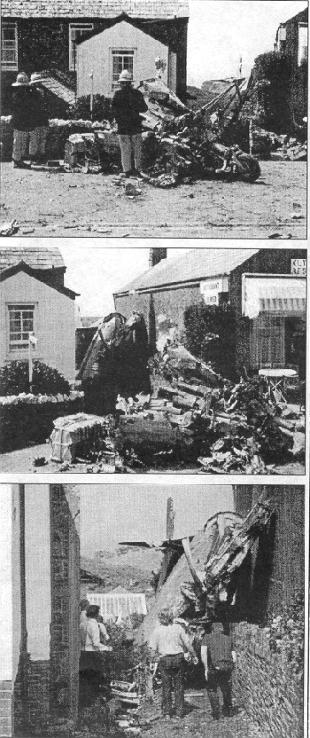
XG197 hit the ground from a shallow descent in a gentle left turn with the
engine still running, and the investigation proved that the RPM at impact was
less than 6100. The airbrake and outer section of the left wing were torn off on
impact. There was then sufficient energy left for the aircraft to bounce and
tear its way a little over 100 yds up to the houses, shedding other parts as it
did so. The fuselage came to rest between two houses and the nose section,
including the cockpit and gun-pack, broke away and came to rest in the main
street.
So what caused this event that touched several lives and totally changed my
own way of life?
A jet engine has a Fuel Control Unit that controls the flow of fuel to the
engine, mainly depending on throttle position, height and speed. An aircraft
engine must be able to cope with extremes of conditions, for example from very
high airspeed at low RPM, to very low airspeed at high RPM, at all heights up to
45000 ft. Two of the vital parameters that are used to control the FCU are
engine intake pressure (P1) and engine compressor pressure (P2). These two
values are taken from small bleeds and are fed to the acceleration control unit
section of the FCU via small diameter pipes. The two bleed pipes cross in a
P1/P2 metering orifice, and the highest pressure determines which side of a
diaphragm is pressurized, and this in turn controls the initial position of the
FCU. The pipework has to be leak free and clean, and where joints are required,
dry paper gaskets are used.
The engine was a newly reconditioned unit. When it was ground run at the
manufacturer’s factory, the P2 bleed from the compressor leaked. The gasket had
to be replaced. However, access to this joint is very restricted, and this was
made worse by the engine now being mounted in a cradle for ground running. A
technique for holding any paper gasket in place while the flange bolts are
positioned is to tack it into place with a little smear of grease. But the use
of grease was specifically forbidden on P1 and P2 pipes… The faulty air bleed
was successfully fixed, and the engine was re-issued to the RAF.
3 hrs 40 mins of flight time later, a small blob of grease, the size of a
match head and now hardened by heat, broke free from the P2 gasket when I
applied power at 525 kts behind the Hawk, and lodged in the P1/P2 metering
orifice of the acceleration control unit in the FCU. The FCU immediately sensed
that the compressor pressure (P2) had dropped to zero, and so responded as
though I was instantly parked on the ground with the engine shut down despite
being at over 500 kts. That was the moment when I thought the engine had surged,
and I was right in thinking it was an unusual surge: in fact, the fuel flow had
gone unstable as the blob of grease moved into the P1/P2 orifice. It then became
impossible to make the engine accelerate, simply because the engine compressor
was sensed as being shut down.
When the FCU was removed from the wreckage it was one of the few parts that
was undamaged. It was bench tested and gave exactly the fuel flow rate that I
had reported. It was then stripped down and the same type of grease that had
blocked the orifice was also found on the P2 paper gasket. With the blob of
grease removed, the FCU was fully serviceable. Analysis showed that it was an
unusual type of silicon grease that is only used on the Dart engine, and the
Dart was also overhauled at the same factory that looked after Avon engines. No
explanation was ever offered as to how this grease came to be present on the P2
gasket in my aircraft, and nobody admitted any involvement.
In his accident report, the RAF Inspector of Flight Safety, an Air Commodore,
commented that ‘Any deviation from laid-down procedures or established safe
practices can cause results out of all proportion to the original action’.
Absolutely correct. He concluded ‘On this occasion it was merely costly: it
could have been tragic’. Absolutely no mention or concern about the pilot’s
injuries.
So began a litany of cunning and deceit by many very senior government, MoD
and Civil Service officials, all intent upon manipulating the truth and avoiding
any real concern for the pilots under their charge. Some years later, the even
more despicable besmirching of the reputation of the pilots who were killed in
the Chinook crash on the Mull of Kintyre was to resonate to the same methods
shown in the handling of my accident.
Many questions could be asked. In the 10 years between 1971 and 1980, total
Hunter flight time was 202,486 hours. In that time there were 26 ejections of
which 6 were fatal. So there was an ejection every 7788 hours and a death every
33,748 hours. We each flew about 250 hrs per year in the Hunter, and so Brawdy
instructors had a 1 in 31 chance of ejecting in any year, and a 1 in 135 chance
of being killed every year. If these were the odds on winning the lottery, you
would bet your pension plan. No aircraft that is so unreliable should have been
left in service, even if it was the magnificent Hunter. Which Air Marshal and
Minister was responsible for forward planning? I bet they didn’t gamble their
pension plans.
If the ejection rate is so high, then what about the seat? Surely the Hunter
would have the best seat possible. Front line aircraft had superb
rocket-propelled ejection seats. The seat in the Hunter was the oldest type left
in service, yet it was installed in the aircraft most likely to use it. The
complete sequence was slow to operate and the firing mechanism was a
spine-breaking gun.
Six months before my accident I had presented Strike Command Engineering and
the Directorate of Flight Safety with a well researched case for refurbishing
the Hunter with a more modern rocket seat. The rocket seat has a hugely
increased safe operating envelope, and the likelihood of injury to the pilot is
small. I was officially told that no other seat could be fitted into the
cockpit. This was a lie. I had personally installed several rocket seat variants
into a cockpit in our ground training facility to prove that they could be
installed on existing cockpit mountings, and Martin Baker Ltd, the world-leading
ejection seat manufacturer, agreed that the installation of the Mk 10(L) rocket
seat would be appropriate and simple. The official line was then changed to one
where the refurbishment could not be justified because of insufficient remaining
in-service life.
A report in July 1980 by the Institute of Aviation Medicine, following the
ejection of Hunter XG261, commented that "Hunter escape capability has not
improved since 1957 but the role of the aircraft has changed considerably and
there is a very real need to bring the escape system up to an acceptable
standard". Deaf ears won the day, and unnecessary injuries and deaths would
continue.
As a result of the accident I lost my medical category, and with that went my
flying career, much of my pay, all my prospects in the RAF, and a great deal of
my mobility. MoD realized that I had a potential case against the engine
manufacturer for damages, and they also realized that the Crown Proceedings Act
of 1947 (now repealed) might not give the Crown the immunity from prosecution
that they always relied upon. The bureaucracy was potentially under attack!
Initially, a thoughtful mandarin at Whitehall suggested that MoD should run a
claim on my behalf in parallel with their own claim against the engine supplier,
but that suggestion was quickly quashed by the Treasury Solicitor. Rather than
assisting me, every obstacle was put in my path. When my MP asked questions in
the House about how my continuing service with the RAF was being handled, the
answers given were carefully crafted lies. I knew that at the time, but could do
nothing. The bureaucracy won another in a long line of victories, which continue
to this day, where trampling on the innocent victims is the name of the game.
The twist is that the Data Protection Act of 1998 now gives the right of
access to all documents, and I have recently obtained the notes, comments and
private papers made by the senior staff involved, including minuted comments on
how proud the MoD and Civil Service staff were with the way they had put their
political master off the trail. The bureaucracy could never have imagined that
their detailed records would ever fall into the hands of their victim!
Too much time and pain has passed to rake over old wounds, and all involved
will have long retired, but I am concerned that things never change. It is a
great pity that so many young men, who initially have so much respect for
others, seem to have a tendency to forget their beliefs and morals as they grow
older and rise through the ranks. A very small number in my case did not do
that. I know who they are, and I thank both of them most sincerely, despite our
mutual failure.
And finally, I acknowledge and regret the disruption to the people of
Tintagel, when I inadvertently came your way.
ACMN 24 Jul 05
Many thanks to Alick Nicholson who I met in Tintagel, along with his wife, on
Friday 29th July 2005.
I took them around the area where the incident involved many
people.
His account of the accident gives highly detailed, sometimes highly
technical details, but of interest to all the people of Tintagel & elsewhere.
Alick wanted to give his TRUE account to villagers & I am proud &
thankful, that Alick decided to tell his account to Tintagelweb.
Thank you Alick on behalf of the residents of Tintagel
David Flower (Webmaster www.tintagelweb.co.uk)